After a collision, the winner is not the one who speaks louder.
The winner is the one who has a plan.
A practical guide that shows you how to secure evidence, avoid being tricked into admitting fault, recognize a staged crash, write an effective driver's statement, and fight for full compensation.
- what to do in the first minutes after a collision
- how not to fall victim to a “cash-for-crash” scammer
- how to defend yourself against an underestimated insurance payout
One collision can cost you far more than the repair itself
Under stress, it is easy to sign the wrong document, give away fault, lose your evidence, or accept a reduced payout just because the other driver or the insurer was faster and better prepared.
Most drivers do not lose after a collision because they are wrong. They lose because they act under stress, trust the wrong person, and give away control too quickly.
You can lose three times after a collision
Pressure at the scene
The other driver may try to impose their version before you calmly assess the situation, take photos, and collect the necessary details.
A mistake in the statement
One badly signed sentence can cost you a fine, penalty points, a higher premium, and long-term problems with fault determination.
A reduced payout
Even when the case seems obvious, you may receive an estimate that does not cover the real repair cost.
A practical collision response system
Not dry theory and not random online tips, but a concrete plan that helps you stay in control from the very first minute after the incident.

The first minutes after the incident
You will get a simple action sequence: what to do first, what not to do, when to secure evidence, and when to stop the conversation.
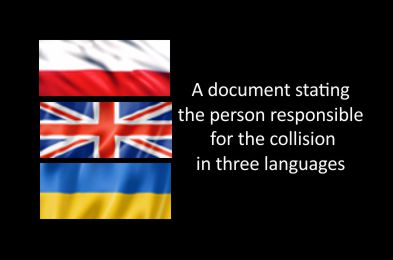
An effective driver's statement
You will learn how to write a document that truly protects your interests and leaves no room for later manipulation.

Calm instead of chaos
This guide was designed so you do not have to think for long on the roadside. You get a ready-to-use action plan instead of improvisation.
Defense against pressure and provocation
You will learn the warning signs and how to react when the other driver tries to outtalk you, intimidate you, or manipulate the formal process.
Learn the rules in Poland.
Don't be manipulated just because you're a foreigner.Learn how to take care of yourself. Know your rights.
What to do after your own mistake
You will learn how to respond if you signed a statement under stress and only later realized that admitting fault was a mistake.
This guide is for drivers who want to act wisely after a collision, not chaotically
For a young driver
If you worry that under stress you might be outtalked by someone more confident, this material gives you a simple plan you can follow without hesitation.
For anyone who does not want to learn the hard way
One badly handled collision can cost far more than the repair itself. It is better to have the procedure in advance than to look for it on the roadside.

Do not learn collision procedure through your own fine, insurance premium, and compensation claim
Instead of improvising after a crash, use a ready system: how to secure the scene, how not to give away fault, how not to accept a reduced payout, and how to regain control of the case.